Physical Address
304 North Cardinal St.
Dorchester Center, MA 02124
Physical Address
304 North Cardinal St.
Dorchester Center, MA 02124

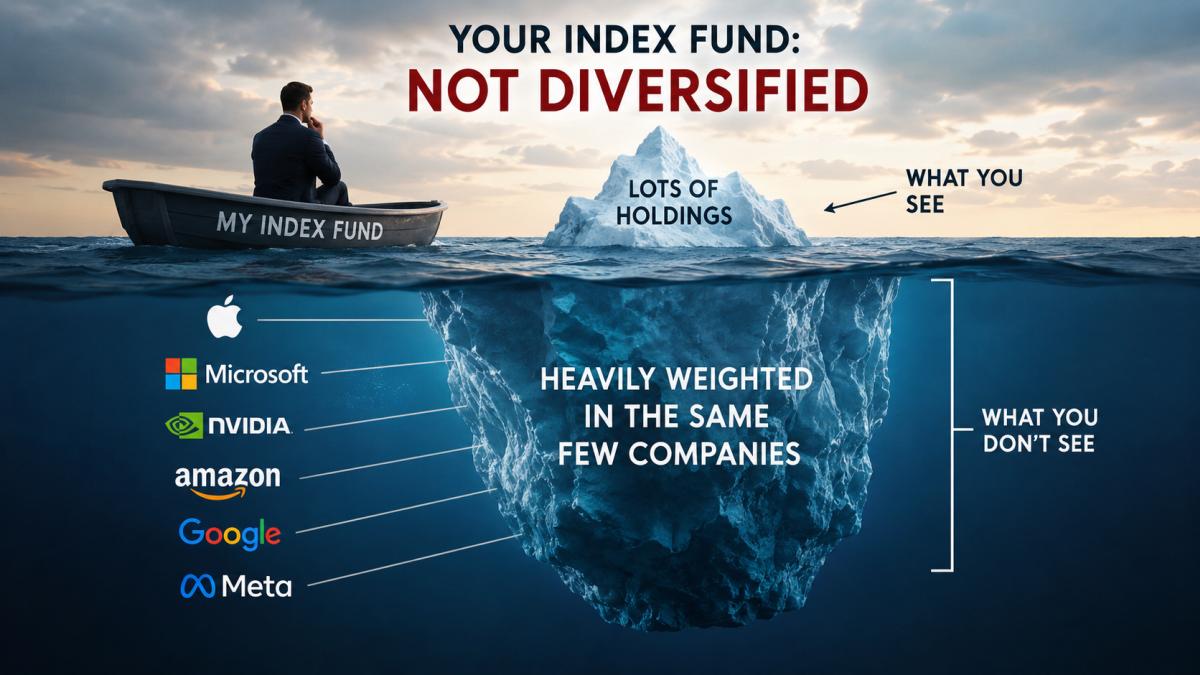
You bought an S&P 500 index fund because you wanted diversification. Five hundred companies across every sector of the American economy. A broad, safe, hands-off approach to building wealth over time. That is the promise, and for decades it delivered. But as of April 2026
You bought an S&P 500 index fund because you wanted diversification. Five hundred companies across every sector of the American economy. A broad, safe, hands-off approach to building wealth over time. That is the promise, and for decades it delivered.
But as of April 2026, the top 10 companies in the S&P 500 account for 35.59% of the entire index. That means more than a third of your “diversified” portfolio depends on the performance of ten stocks, most of them in the same sector, all of them sensitive to the same macroeconomic forces. You are not holding 500 companies. You are holding a concentrated tech bet with 490 names attached as an afterthought.
This is not a fringe observation. The New York Times reported in January 2026 that U.S. stock markets have become so concentrated that even broad index funds are no longer well diversified. The article echoed what quantitative analysts had been warning for years: the “Great Narrowing” of the S&P 500 has fundamentally changed what it means to own the index.
Between 1990 and 2015, the top 10 stocks in the S&P 500 hovered between 18% and 23% of total index weight. That was already concentrated, but it was stable. No single sector dominated for long. Technology, financials, healthcare, and consumer goods rotated through the top positions as cycles turned.
Then something changed. According to RBC Wealth Management, the top 10 weighting nearly doubled in a single decade, hitting a record 40.7% in 2025 before settling at 35.59% in April 2026. The driver was almost entirely megacap technology and AI-related stocks. Microsoft, Apple, NVIDIA, Amazon, Alphabet, and Meta grew so large that their market caps swallowed the rest of the index.
The problem is not that these are bad companies. They are extraordinary companies. The problem is that your index fund is no longer giving you what you paid for, which is exposure to a broad market. It is giving you a leveraged bet on a handful of names that all move together when the narrative shifts.
When the top 10 stocks make up over a third of your portfolio, several risks compound at once:
Single-sector exposure: Most of the top 10 are technology companies. If AI spending slows, if regulatory action hits big tech, or if interest rates stay higher for longer, the entire top of your portfolio moves in the same direction at the same time. As Finance Core Tech noted in their 2026 analysis, this is not a diversified portfolio. It is a sector fund wearing a diversified costume.
Valuation compression risk: The megacaps trade at premium multiples justified by AI growth expectations. If those expectations cool, even slightly, the repricing hits a third of your portfolio simultaneously. The other 490 stocks cannot offset that kind of weight.
Correlation disguised as diversification: The S&P 500’s Herfindahl-Hirschman Index, a standard measure of market concentration, sits at 185 as of April 2026, well above its 5-year average of 142. In plain terms, the index is more concentrated now than it has been at any point in recent history, including during the dot-com bubble.
There is a solution that most retail investors have never heard of: equal-weight index funds. Instead of weighting companies by market cap, an equal-weight fund gives every stock in the S&P 500 the same allocation, roughly 0.2% each. Apple gets the same weight as a mid-cap industrial company. NVIDIA gets the same weight as a regional bank.
The result is actual diversification. Equal-weight ETFs have been outpacing the cap-weighted S&P 500 in 2026 as megacap dominance begins to fade. The Invesco S&P 500 Equal Weight ETF (RSP) and similar products give you the same 500 companies but without the concentration bet baked into the structure.
S&P Dow Jones Indices, which maintains both versions, notes that the equal-weight index has historically generated over 50% of its excess return from its larger allocation to smaller constituents. It systematically rebalances away from stocks that have grown the most and toward those that have lagged. In other words, it does what investors are told to do but rarely manage: buy low, sell high, automatically.
Yes, and that matters. Broad market index funds now cost as little as 0.03% annually, and that cost advantage is real. Equal-weight funds typically charge between 0.20% and 0.40%, which is higher but still far below active management fees. The question is whether that extra cost buys you meaningful risk reduction.
In a market where a third of your portfolio sits in 10 names, the answer is yes. The fee difference between a 0.03% cap-weight fund and a 0.20% equal-weight fund on a $100,000 portfolio is about $170 per year. That is a small price to pay for cutting your single-stock concentration risk by more than half.
The bigger issue is that the active-versus-passive debate, as Global Investments frames it in their 2026 guide, is not really about active versus passive anymore. It is about whether your passive strategy is actually passive, or whether it is making an aggressive concentrated bet on a handful of stocks by default.
There are signs that the market is already adjusting. FinancialContent reported in March 2026 that a “Great Rotation” was underway, with capital flowing from megacap tech into the “real economy” sectors that had been starved of attention during the AI boom. Industrial stocks, financials, and healthcare names started catching bids as investors realized the rest of the market had been left behind.
If that rotation continues, cap-weighted index funds will lag equal-weight alternatives for an extended period. The same structural feature that boosted the S&P 500 during the AI rally, namely its heavy weighting toward the top 10, will work against it on the way down. That is not a prediction. It is just how math works when 10 stocks are a third of the index.
None of this means you should abandon index funds. The evidence for passive investing over the long run is still overwhelming. But it does mean you should think about which index fund you own and what it actually holds.
Here is a practical framework:
First, check your portfolio. If you hold a single S&P 500 cap-weighted fund, you are more concentrated than you think. Look at the top 10 holdings. If you would not deliberately put 35% of your money into those specific 10 companies, then your index fund is making a bet you would not make yourself.
Second, consider splitting your allocation. A blend of cap-weighted and equal-weighted S&P 500 funds gives you exposure to the megacap growth story while maintaining genuine diversification across the remaining 490 companies. A 70/30 split between cap-weight and equal-weight is a reasonable starting point.
Third, look beyond U.S. equities. The concentration problem is specific to U.S. large-cap indices. International index funds, small-cap funds, and bond funds do not have the same structural issue. If your entire portfolio is one U.S. S&P 500 fund, you have two concentration risks: the top 10 stock problem and the single-country problem.
The rise of passive investing was supposed to democratize the market. Instead, it funneled trillions of dollars into the same handful of stocks, creating a feedback loop where the biggest companies get bigger simply because they are big. Every dollar that flows into an S&P 500 index fund buys more of Microsoft and NVIDIA and less of everything else, regardless of whether those are the best places to deploy capital.
This is not a bubble call. It is not a prediction of a crash. It is a structural observation: the tool you are using for diversification has quietly stopped diversifying. The index changed underneath you, and nobody sent a memo.
The good news is that the fix is simple, cheap, and available. Equal-weight funds, international exposure, and a clear understanding of what you actually own can restore the diversification you thought you already had. The first step is simply looking under the hood.
For more on how market structure affects your investments, see our earlier piece on the quiet rotation of capital away from legacy sectors.