Physical Address
304 North Cardinal St.
Dorchester Center, MA 02124
Physical Address
304 North Cardinal St.
Dorchester Center, MA 02124

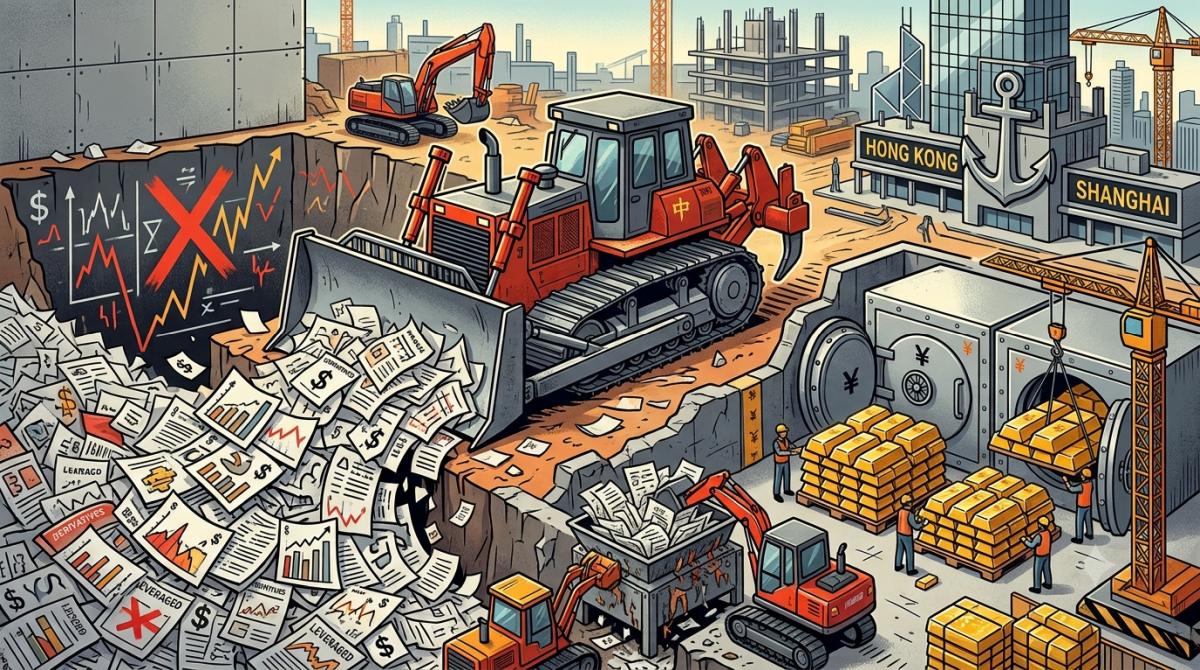
On July 24, retail gold trading through some of China's largest banks goes dark. If you are a Chinese citizen who buys and sells gold through your banking app, your access gets switched off. This is not a rumor or a forecast. The Industrial and Commercial Bank of China, the largest bank on earth by assets, announced it will stop...
On July 24, retail gold trading through some of China’s largest banks goes dark. If you are a Chinese citizen who buys and sells gold through your banking app, your access gets switched off. This is not a rumor or a forecast. The Industrial and Commercial Bank of China, the largest bank on earth by assets, announced it will stop offering intermediary services for individuals to trade precious metals on the Shanghai Gold Exchange after settlement on that date. Existing clients have been told to close their positions or take delivery before the deadline.
ICBC is not acting alone. Postal Savings Bank of China, Ping An Bank, China Guangfa Bank, and China Construction Bank have all announced parallel exits from the same product category. China Guangfa went further, asking clients to close positions before a set deadline or face forced liquidation by month end. One after another, the biggest financial institutions in the world’s largest gold market are shutting down retail access to leveraged bullion trading.
The official explanation is straightforward. Prices got violent. Gold hit a record near $5,600 an ounce in January, then fell below $4,000 as a strengthening dollar and receding rate-cut expectations knocked the wind out of the rally. That is close to a 30 percent drawdown from peak, one of the sharpest gold corrections in modern market history. To protect retail traders from that volatility, banks jacked up margin requirements to punishing levels, with some products requiring collateral of well over 100 percent of exposure. When you have to post more than a dollar to hold a dollar of position, the message is unambiguous: leave.
That is the surface story. It is true as far as it goes. But it leaves out the more interesting question of what China is actually shutting down, and what it is quietly building in its place.
Read the fine print of these announcements and a pattern emerges. What is being withdrawn is leveraged, deferred, paper-based speculation. What survives untouched is physical gold. Investors can still buy gold accumulation products. They can still buy exchange-traded funds. They can still own bars and coins. The Global Times noted that some banks even cut transaction fees on their physical accumulation plans while forcing traders out of the leveraged contracts.
So this is not China turning citizens away from gold. It is China turning them away from the paper claims on gold while nudging them toward the metal itself. That distinction matters, because those are two very different assets that happen to share a name.
Paper gold works like a certificate of ownership that trades in place of the thing it represents. In the large Western venues, London and the New York futures market, the overwhelming majority of gold that changes hands every day is never physically delivered. Buyers and sellers trade contracts, claims on metal, and most never intend to collect a single bar. The problem with any claims-based market is that the volume of claims can drift far above the volume of underlying metal sitting in vaults. Nobody knows the exact ratio, because nobody knows precisely how much physical gold exists or how much paper is written against it. But the structural point holds: there is dramatically more paper than metal. And when paper supply swamps physical supply, the price the market discovers reflects the paper, which sits lower than a purely physical market would clear.
If that theory were true, what would the fingerprints look like? Two things.
First, a persistent gap between the price of physical metal and the price of the paper claim. In an honest market, they trade in lockstep. When they diverge, buyers are signaling they will pay a premium for the real thing because they no longer fully trust the paper. The silver market flashed exactly this signal earlier in the year, with the spread between physical and paper widening dramatically at the peak before narrowing again. Gold’s spread is far tighter, which is why this remains a theory rather than a proven case. But tellingly, Shanghai gold recently traded at a discount to London quotes, a reminder that regional physical markets can and do decouple from the paper benchmarks.
Second, and more compelling, watch what the most sophisticated buyers on the planet actually do. If you believed the paper was suppressing the price, you would sell the paper and buy the metal. That is precisely what central banks have been doing at a historic pace. They purchased a net 244 tonnes in the first quarter of 2026, exceeding both the prior quarter and the five-year average. Net purchases have now topped 200 tonnes in ten of the last eleven quarters. And a chunk of this buying never shows up in official reports. The World Gold Council explicitly estimates undisclosed purchases as the residual between total demand and reported acquisitions, a gap that has stayed elevated since 2022.
The other half of the trade is what these buyers are selling to fund it. For decades the reserve-management playbook was simple: park surplus dollars in US Treasuries and earn a yield. That consensus has cracked. Chinese holdings of US debt have been drawn down for years, rotated steadily into gold. The trigger was 2022, when Western governments froze roughly $300 billion in Russian central bank reserves within days of the Ukraine invasion. Every reserve manager on earth absorbed the same lesson at once: dollar reserves held abroad are only as safe as your political relationship with the country that runs the clearing system. Gold in a sovereign vault answers to nobody. It cannot be frozen or sanctioned.
Chinese household demand tells the same story. Bar and coin buying hit a record 207 tonnes in a single quarter, breaking a record that had stood since 2013. This is physical metal being pulled out of the deliverable pool and locked away.
Here is where the retail shutdown stops looking like consumer protection and starts looking like clearing the field. China is building a parallel gold settlement architecture, and it is doing so on almost the same timeline as the July 24 trading cutoff.
Hong Kong is standing up a fully state-owned central clearing system for gold, with trial operations targeted around the middle of the year. It is being built in formal cooperation with the Shanghai Gold Exchange, which is co-designing the infrastructure rather than merely advising. The division of labor is deliberate. Shanghai anchors onshore physical delivery and domestic price discovery. Hong Kong provides the offshore gateway that international counterparties can actually reach, since mainland capital controls keep foreigners at arm’s length from Shanghai directly.
The scale of the ambition shows up in the vaults. Hong Kong plans to expand physical storage capacity from around 200 tonnes to over 2,000 tonnes within three years. You do not build vault capacity like that for a paper casino. You build it because you intend to settle in real metal, and physical settlement forces the price to reflect genuine supply and demand rather than a mountain of claims. That is the entire point: real price discovery, denominated and settled in renminbi.
The strategic logic runs deeper than gold itself. The world does not yet fully trust the yuan, because it is state-controlled and not freely convertible. But the world does trust gold. If major commodity deals can be priced in yuan and settled against physical metal sitting in a Shanghai-linked vault, then the currency inherits an anchor. Not a formal gold standard, but something that ties the yuan to the one asset no government can print. That is how China challenges dollar primacy without firing a shot. The head of the Shanghai Gold Exchange signaled this intent back in 2014, telling the London bullion establishment that once China had a real seat at the table, gold’s true price would finally be revealed.
None of this is lost on the other side. And the counter-move is already sketched out.
The US government carries its gold, more than 8,100 tonnes, on the Treasury’s books at a statutory price of $42.22 an ounce, a relic of a 1973 law never updated. At that price the entire hoard is valued around $11 billion. At market prices it is worth somewhere between $750 billion and a trillion dollars. That trillion-dollar gap is hidden by nothing more than an accounting convention from the Nixon era. Revalue the gold with the stroke of a pen and that value materializes on the Treasury’s balance sheet, spendable without issuing a single new bond.
This is not fringe speculation. The Treasury Secretary has publicly pledged to monetize the asset side of the US balance sheet. The Federal Reserve published a research paper in 2026 examining how other nations have revalued reserves to book gains, studying cases in Germany, Italy, Lebanon, and elsewhere. And economist Judy Shelton has been pushing a 50-year gold-convertible Treasury bond, redeemable at maturity in either dollars or a fixed weight of gold, framed for issuance around a symbolically loaded July date. It is, functionally, the same trick China is running with the yuan: attach the sovereign’s debt to the one asset that cannot be debased.
Whether any specific revaluation happens on any specific date is unknowable and mostly beside the point. The mechanism does not even require gold to rise. If the dollar falls far enough, the outcome is identical.
Strip away the machinery and both sides are making the same wager. Central banks are dumping paper promises and hoarding metal, hiding how much. China is dismantling retail paper speculation while pouring concrete for physical settlement vaults. The US is eyeing a stroke-of-the-pen revaluation of gold it has undervalued for half a century. These are not the moves of institutions that believe the current paper-priced, dollar-settled monetary order is permanent.
The July 24 shutdown of retail paper gold in China is a small operational event. But read alongside the Hong Kong vault buildout, the record central bank accumulation, the steady sale of Treasuries, and the Western revaluation chatter, it stops looking like a footnote and starts looking like one more brick pulled from a wall. The battle over what counts as money, and who gets to set its price, is no longer theoretical. It is being fought in vaults and on balance sheets right now.