Physical Address
304 North Cardinal St.
Dorchester Center, MA 02124
Physical Address
304 North Cardinal St.
Dorchester Center, MA 02124

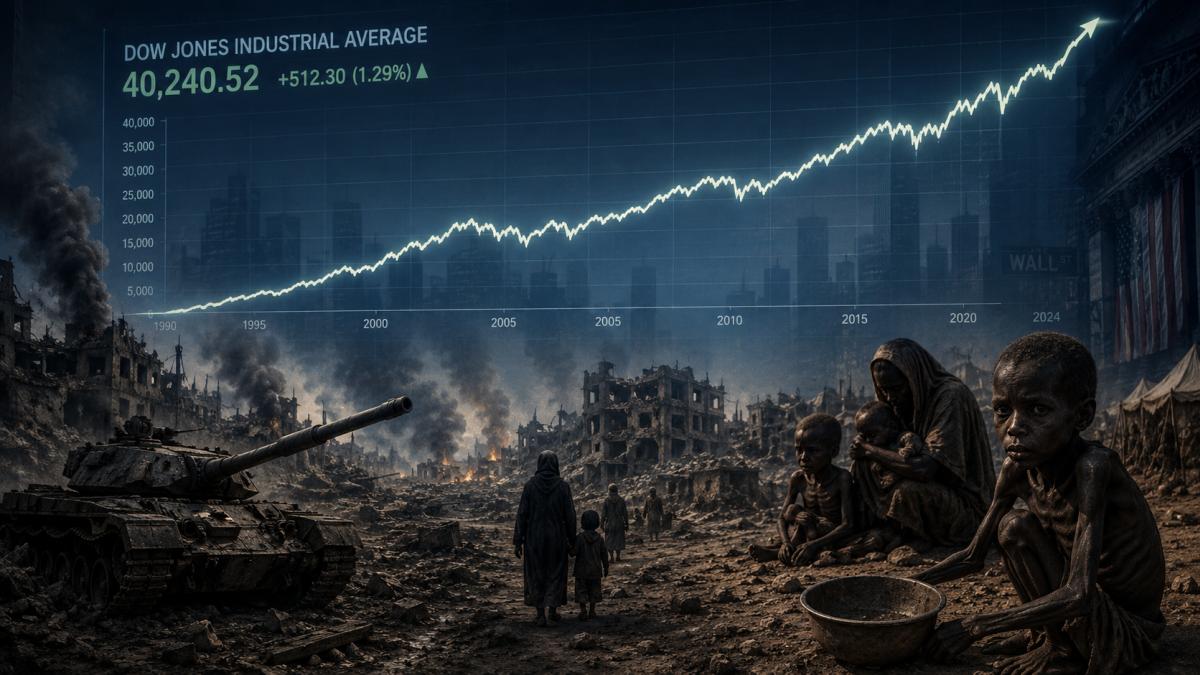
War headlines. Oil shocks. Rent that swallows a paycheck. And somehow, against all of it, the index prints another record. The instinct is to call the whole thing a casino, rigged and detached, a number that means nothing. That instinct is half right and far more dangerous than the casino theory, because the market is not detached at all. It is measuring something real. It is just measuring something most people were never told to look at.
War headlines. Oil shocks. Rent that swallows a paycheck. And somehow, against all of it, the index prints another record. The instinct is to call the whole thing a casino, rigged and detached, a number that means nothing. That instinct is half right and far more dangerous than the casino theory, because the market is not detached at all. It is measuring something real. It is just measuring something most people were never told to look at.
[Also See: Why Britons Avoid Stock Market Investing]
The contrarian move here is not to dismiss record highs as noise. It is to take them seriously, then ask the uncomfortable question that follows: if the market is functioning perfectly, what exactly is it telling us about who the economy now works for?
The first error is treating the market as a national mood ring. Calm world, prices rise. Chaotic world, prices fall. Clean, intuitive, and mostly wrong. The market does not price how ordinary people feel, whether wages keep up with groceries, or whether the world is at peace. It prices four narrow things: expected future profits, the level of interest rates, where capital is being forced to flow, and what traders are mechanically obligated to do today.
None of those four require a happy population. A company can post record margins while its customers quietly tighten their belts. That gap, between corporate profit and household experience, is not a glitch. It is the entire story.
When a record high flashes across a screen, it is easy to imagine 500 thriving businesses lifting in unison. The reality is far narrower. The ten largest companies in the S&P 500 now account for roughly 38 to 40 percent of the entire index by market value, a level of concentration analysts describe as the highest on record. The so-called Magnificent Seven alone have at times made up around 40 percent of the benchmark, which means forty cents of every passive dollar now flows into just seven names.
This matters more than most investors admit. A record on the S&P 500 is no longer a referendum on the broad economy. It is increasingly a referendum on whether a small cluster of dominant firms is making, or is expected to make, enormous profits. Your rent can stay unaffordable, your wages can stagnate, and the index can still hit an all-time high, because the index and your life are measuring two different things. As one analysis of the growing weight of the top ten holdings notes, those giants generate a wildly disproportionate share of total corporate earnings, which is precisely why the market tolerates leaning on them so heavily.
The second misunderstanding is assuming markets only climb on genuinely good news. Often they climb on news that is simply less terrible than feared. Picture walking into an exam certain you failed, then receiving a mediocre but passing grade. Objectively unremarkable. Emotionally, a victory. Markets behave identically.
When investors have already priced in the worst case, oil spiking, trade routes closing, escalation spiralling, then even a small reduction in that fear is enough to move prices sharply higher. A single headline hinting at a ceasefire can spark a rally, not because the world became good, but because the world became marginally less bad than the price already assumed. Relief, not optimism, is frequently the fuel. This is also why trying to trade the news directly is a trap: the move depends on the gap between reality and expectation, not on the event itself.
Strip the explanation down to its mechanics. When rates are high, parking money in the bank is genuinely attractive. When a central bank cuts, that calculus inverts. Cash sitting idle, possibly eroded by inflation, suddenly looks like a slow leak, and capital goes hunting for anything that might outpace it: equities, property, gold, private businesses, even speculative digital tokens. When enough money chases the same assets, their prices rise. That is the whole mechanism.
After 2008 and again through the pandemic, central banks slashed rates aggressively, and the price of nearly everything inflated in response, from stocks and housing to bonds and collectibles. But here is the wrinkle the casino crowd misses. Rates in 2026 are markedly higher than in those eras, yet markets keep printing records anyway. The tidy low rates explain everything narrative no longer holds. Something else is doing the lifting.
That something is the plumbing of crisis spending. When the economy threatens to seize, governments flood it with money. Some reaches ordinary households. A great deal flows to companies, banks, defence contractors, energy firms, and bondholders, and over time a large share settles with people and institutions that already own assets.
The behavioural split is the part worth burning into memory. Hand an ordinary household extra money and it gets spent: rent, food, a repaired car, a replaced appliance. Hand a wealthy individual or a large institution extra money and it buys assets: equities, property, bonds, whole companies. So when crisis money accumulates at the top, it does not chase goods, it chases assets, and asset prices rise. A perpetually rising market is therefore not only a sign of prosperity. It is a readout of wealth concentrating upward. Rising prices make existing asset owners richer and make it harder for everyone else to ever catch up. Politicians can wave at record highs as proof the country is thriving, even as those same highs quietly document widening inequality, a dynamic the data on post-pandemic wealth gains flowing to asset holders makes difficult to dismiss.
There is a further layer beneath the asset bid: a slow erosion of faith in currency itself. Every crisis met with fresh money dilutes the value of money already in circulation. The arithmetic is unforgiving. U.S. national debt has now crossed 39 trillion dollars, and servicing it costs in the region of 2.9 billion dollars every single day, roughly a trillion a year, more than the entire defence budget, just to carry the balance without paying a cent of it down. As the daily interest burden grinds higher with each refinancing of older low-rate debt at today’s yields, the incentive to hold cash weakens further. In that environment, investors do not sit in currency they expect to lose value. They rotate into stocks, property, gold, and Bitcoin, anything perceived to defend purchasing power better than the dollar in their account. Part of the market’s ascent is not enthusiasm for businesses at all. It is a quiet vote against the money used to price them.
The final layer is the one financial news skips entirely: most trading is now automated, and algorithms do not weigh geopolitics. They read price. If the trend points down, they sell or short. If the trend flips up, they buy. So when prices punch through certain technical levels, these systems can mechanically swing from bearish to bullish, unleashing another wave of buying that has nothing to do with fundamentals.
Then come the options dealers. A call option is a bet that a stock will rise. When traders pile into calls, the firms that sold those contracts often hedge by buying the underlying shares. That buying nudges price higher, which triggers trend-following algorithms, which buy more, which lifts price again. A modest piece of good news can snowball into a violent rally as the buying feeds on itself, a reflexive loop with no natural brake until it exhausts. None of this reflects a healthier economy. It reflects market structure doing what market structure does.
Put the four layers together, concentration, relief rallies, the asset bid from crisis money, and mechanical feedback loops, and record highs in the middle of chaos stop looking mysterious. They start looking like exactly what you would expect from a system built to price assets rather than wellbeing. Prices cannot compound exponentially forever; something eventually gives, and the unwind is rarely gentle.
The contrarian takeaway is not to short the record or cheer it. It is to stop asking the wrong question. The useful question was never why are stocks going up. It is who actually gets richer when they do, and the honest answer reframes every headline that follows. The faster asset prices climb, the faster the gap widens between those who own assets and those who do not. Treat the record not as a verdict on the economy, but as a measurement of how concentrated ownership has become. Invest accordingly, and read the next celebratory headline with the skepticism it has earned.