Physical Address
304 North Cardinal St.
Dorchester Center, MA 02124
Physical Address
304 North Cardinal St.
Dorchester Center, MA 02124

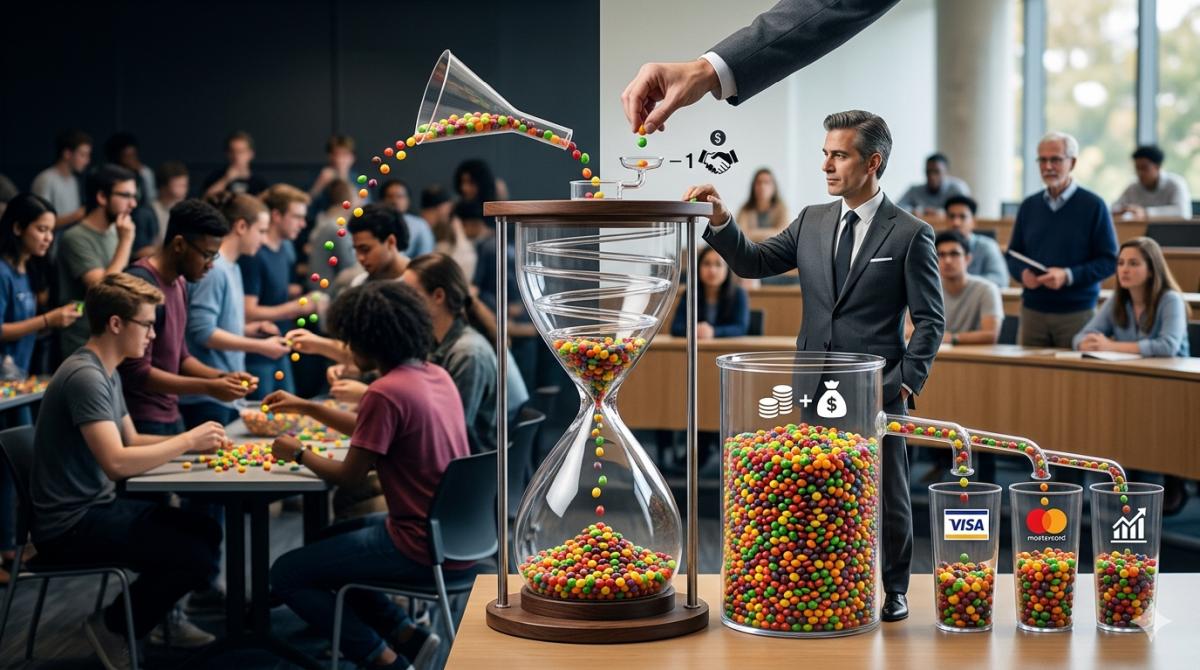
A professor at Duke recently ran an experiment with his Silicon Valley class. He handed each student a bag of Skittles and set them loose: trade your way to a single-color hoard, and the biggest hoard of each color earns a free pass on a homework assignment. Twenty minutes, open-floor haggling, all the frantic strategy you would expect from ambitious students. Who's holding the reds? Should I dump my purples early? Can I trust the guy in the corner?
A professor at Duke recently ran an experiment with his Silicon Valley class. He handed each student a bag of Skittles and set them loose: trade your way to a single-color hoard, and the biggest hoard of each color earns a free pass on a homework assignment. Twenty minutes, open-floor haggling, all the frantic strategy you would expect from ambitious students. Who’s holding the reds? Should I dump my purples early? Can I trust the guy in the corner?
There was one rule that nobody thought hard enough about. To make a trade official, you had to report it to the professor — the self-appointed “Skittle trade commissioner” — and he logged it on a spreadsheet. The fee for recording the trade was one Skittle per participant. He never traded. He never competed. He simply taxed the activity. By the end of the session, the commissioner had more Skittles than almost anyone in the room.
It is a children’s-candy version of one of the most durable ideas in finance, and it deserves to be taken seriously by anyone allocating capital: the player competes for the prize, but the operator collects on every move regardless of who wins. The students were so absorbed in the game that they never asked who designed it, or why the design guaranteed the designer’s victory. That single oversight is worth more than any trading tactic they could have devised.
The clearest real-world version of the Skittle commissioner is the card network. Every time a consumer taps a card, a chain of fees fires, and the merchant absorbs a deduction of roughly 2-3% in the United States that is actually an aggregate of interchange, scheme assessments, and acquirer markups flowing to different parties. The networks sit in the middle of this and barely touch the goods being sold. In fiscal 2025, Visa processed around $14 trillion in payments volume across 258 billion transactions, turning that flow into roughly $40 billion in net revenue, while Mastercard handled $9.2 trillion in gross dollar volume the same year. Neither company manufactures a single product that shows up in your shopping bag. They tax the act of buying it.
What makes this a genuine moat rather than a clever fee is the structure underneath it. The duopoly rests on two-sided network effects — more cardholders make the rails more attractive to merchants, and wider acceptance makes the cards more useful to consumers — and as of 2025 Visa held 52.2% of global credit card market share with Mastercard at 21.6%, together accounting for nearly three-quarters of global volume. The flywheel has been spinning for decades, and it spins whether the economy booms or busts, because people transact in both.
The exchanges play the same game in a different building. CME Group is openly described as the toll road of global finance, earning a cut every time a trader hedges interest rates, commodities, or currencies. In the third quarter of 2025 alone, its clearing and transaction fees generated $1.2 billion at an average rate of about $0.70 per contract, and the company retains the pricing power to raise rates with minimal customer defection because there is no viable alternative at scale. The trader can be long or short, right or wrong, ruined or enriched. The clearinghouse logs the trade and takes its Skittle either way.
Once you see the pattern, it is everywhere. The stock exchange collects on every buy and every sell. The sports franchise owner profits whether the team makes the playoffs or finishes last. The social platform sells your attention to advertisers while you chase likes that cost the platform nothing to dispense. In each case the participants are emotionally invested in an outcome — winning the game — while the operator is financially invested in the volume of play. Those are not the same incentive, and the gap between them is precisely where durable wealth accumulates.
This is the contrarian point, and it cuts against most of what passes for investing advice. The crowd spends its energy trying to win the game: picking the stock that beats the market, finding the trade that prints, backing the team that lifts the trophy. That is the equivalent of the students fighting over reds and purples. The harder, quieter question — the one the professor wanted his class to ask — is who designed the game and why it pays them. In markets, the answer points you toward the venue rather than the contestants: the network, the exchange, the clearinghouse, the platform, the rail. These businesses are frequently less exciting than the assets traded across them, which is exactly why they are chronically under-appreciated by an audience trained to want excitement.
There is one more lesson buried in the candy. Interchange is not a law of physics. India’s Unified Payments Interface processes billions of transactions monthly with zero merchant fees, funded by government subsidies and bank cross-selling, which demonstrates that the toll is a business-model choice and not a technological necessity. Toll booths can be torn down by regulators, disrupted by public infrastructure, or eroded by alternative rails — and the recent $200 billion settlement over swipe fees, which trims interchange modestly over several years, is a reminder that even the commissioner is not untouchable. The moat is wide. It is not infinite.
None of this is a recommendation to buy a specific name; it is a recommendation to change the question you ask. When you evaluate an opportunity, stop asking only “will this win?” and start asking “who gets paid no matter what happens here, and can I be on that side of the table?” Sometimes the answer is to own the operator instead of betting on the players. Sometimes it is to recognize that you are the player being taxed and to reduce how often you transact, since every trade is a Skittle handed to someone whose business is your activity. And sometimes it is simply to notice that you are inside a game you did not design, competing for a prize that may matter far less than it feels like it does in the heat of the twenty minutes.
The students will tour Apple, Meta, and Google later this month — three of the most successful game-designers ever built, companies whose entire architecture is to position themselves where value flows and collect a fraction of it. Odds are the candy will stick in their memory longer than the campuses. It should. The lesson is the same in both places: the durable money is rarely made by the contestant straining for the prize. It is made by whoever owns the spreadsheet.
Market Mind Investor publishes contrarian analysis. Nothing here is investment advice; do your own research and consider your own circumstances before acting.