Physical Address
304 North Cardinal St.
Dorchester Center, MA 02124
Physical Address
304 North Cardinal St.
Dorchester Center, MA 02124

There is a feeling that repeats itself in markets. It is not panic, exactly. It is something quieter and more insidious. It is the feeling that buying anything right now would be stupid, that only a fool would step in front of a moving train, and that patience means waiting until things are obviously better before committing capital.
There is a feeling that repeats itself in markets. It is not panic, exactly. It is something quieter and more insidious. It is the feeling that buying anything right now would be stupid, that only a fool would step in front of a moving train, and that patience means waiting until things are obviously better before committing capital.
That feeling tends to be loudest at exactly the wrong time.
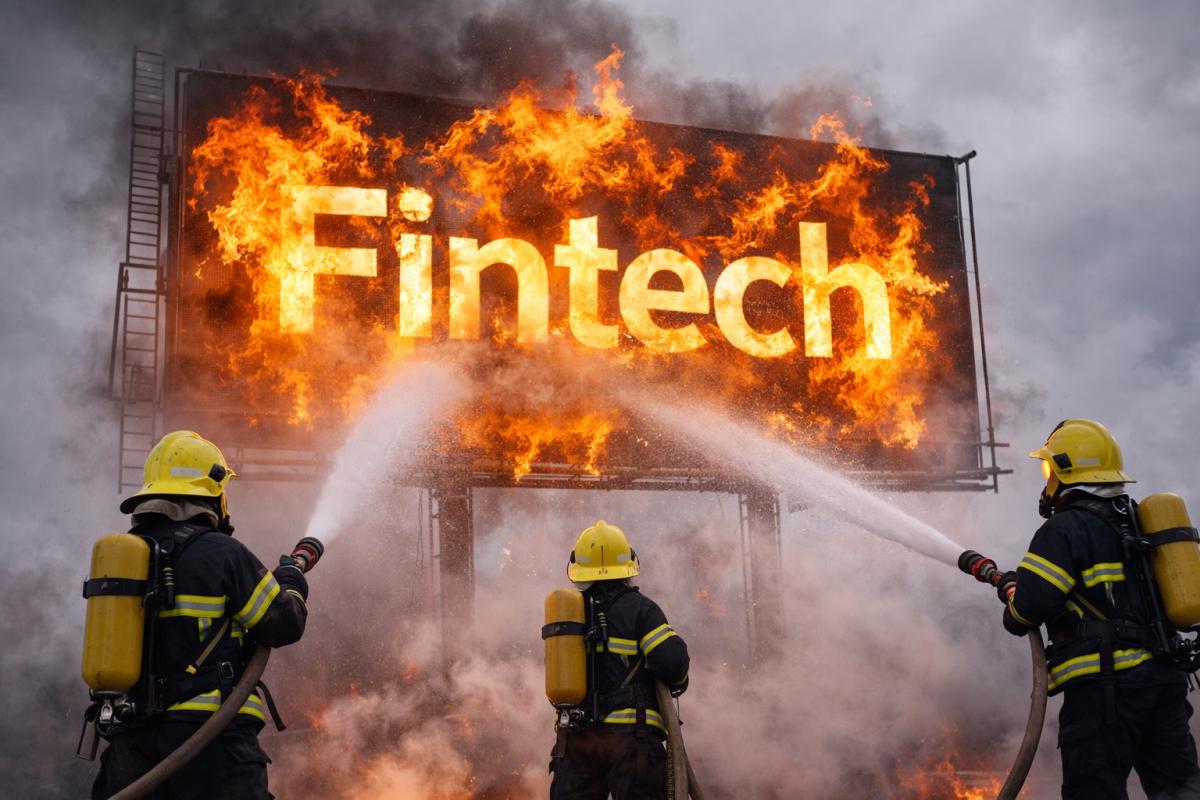
Right now, that feeling is pointed directly at fintech.
Public fintech stocks have had a brutal start to 2026. A price-weighted index tracking 15 of the most prominent names in the sector is already down 29% through March. For context, the worst point of the brutal 2022 selloff produced a drawdown of around 34% for a comparable basket of stocks. We are nearly matching that trough, and the calendar has barely turned.
The Nasdaq is down close to 10% from its highs. IGV, the ETF that tracks software companies, has fallen around 25%. The word “recession” is appearing in more headlines each week. The Middle East remains a flashpoint. And everywhere you look, analysts are debating whether artificial intelligence will hollow out the fintech business model entirely.
In short: it feels like a terrible time to buy fintech stocks.
Which is, historically speaking, exactly when you should be doing your homework.
Cast your mind back to mid-2022. The Federal Reserve was raising interest rates at the fastest pace in decades. Growth stocks were being repriced violently. Fintech, which had soared during the era of zero rates and pandemic-era consumer spending booms, was being punished severely.
At the time, nobody knew when it would end. The pain felt permanent. Buying Robinhood at under $8 seemed reckless. Picking up Nubank under $4 felt like catching a falling knife. Shopify under $30 looked like a company in structural decline.
None of that was true. Investors who held their nerve or, better still, added to positions during the carnage were rewarded enormously in the years that followed. The same names that looked broken in 2022 went on to reach prices that made those entry points look like gifts.
The lesson is not that markets always recover quickly. Sometimes they do not. The lesson is that the periods when buying feels most irrational are frequently the periods when buying is most rational.
The specific fears driving the 2026 selloff are different from 2022. There is no aggressive Fed tightening cycle this time. Instead, the concerns cluster around three themes: AI disruption threatening incumbent fintech business models, geopolitical risk (particularly in the Middle East) raising the prospect of an energy shock, and the creeping worry that the global economy is heading into a slowdown.
Each of those concerns has some merit. AI is genuinely going to change how financial services are delivered. Geopolitical risk is real. Recessions do happen.
But consider what these fears are being applied to. Adyen processes payments for a significant share of global commerce. The realistic scenario in which a new entrant displaces their infrastructure in the next few years is difficult to construct. Stripe, still private but increasingly influential in discussions of fintech durability, has built a developer ecosystem that would take a decade to replicate. Affirm and Klarna have first-mover advantages in buy-now-pay-later that are backed by underwriting data no startup can match. Shopify has become the operating system for independent commerce globally.
These are not fragile businesses. They are, in most cases, becoming more deeply embedded in economic infrastructure, not less.
While sentiment was collapsing, Revolut published its 2025 annual report, and the numbers were difficult to argue with. Revenue climbed 46% to £4.5 billion, profit before tax hit £1.7 billion (up 57%), and the customer base reached 68.3 million after 16 million new users joined during the year. Customer balances grew 66% to £50.2 billion.
What is particularly notable about Revolut’s model is the revenue composition. Around 76% of revenue comes from fees rather than net interest margin, which means the business is less exposed to rate cycles than a traditional bank. Card payments, subscriptions, wealth products, and foreign exchange each contribute meaningfully to the top line.
The expansion story is also just getting started. Revolut remains overwhelmingly a European business by revenue today, with only around 4.4% of fee income originating outside Europe. But the company has filed for a US national bank charter, secured licenses in Colombia and Mexico, received in-principle approval for a UAE payments license, and is working toward a full banking license in South Africa. The addressable market ahead of them dwarfs what they have captured so far.
Not every fintech headline this week was a win. Circle, the company behind the USDC stablecoin, saw its shares fall more than 20% in a single session after a draft of the Clarity Act included language that would prohibit digital asset service providers from offering yield on stablecoin balances.
The proposed language is broad. Anything economically equivalent to bank interest would be prohibited under the draft text, though activity-based rewards tied to actual payment and transaction behavior would still be permitted. Regulators would have a year after passage to define the precise boundaries.
Yield-bearing stablecoins have become a genuine growth driver for parts of the crypto and fintech ecosystem, so the regulatory risk is real. But regulatory risk in fintech is not new, and companies with strong fundamentals tend to adapt. Expect issuers to restructure rewards programs, find permissible structures, and continue building. The stablecoin market has survived far more turbulent regulatory environments than a draft bill with yet-to-be-defined enforcement rules.
In a move that is either a sign of renewed strategic focus or an admission of how long product integration can take, PayPal has finally enabled direct transfers between Venmo’s 67 million users and PayPal’s 200 million global users across 90 markets. The two products have been under the same corporate roof since PayPal acquired Venmo through the Braintree transaction in 2013.
The timing matters for a reason beyond the product itself. PayPal’s board pushed out CEO Alex Chriss in February, and incoming CEO Enrique Lores is expected to sharpen the company’s focus and exit businesses that do not fit the core strategy. Deepening the connection between Venmo and PayPal sends a clear signal that Venmo is not being sold. You do not invest in integrating two platforms if one of them is headed for a divestiture.
Whether this translates into genuine revenue growth is a separate question. But the optionality of a unified PayPal and Venmo network, operating across 90 markets with the full weight of PayPal’s merchant relationships behind it, is not trivial.
Contrarian investing is frequently misunderstood. It is not about buying everything that is falling. It is about identifying businesses with durable competitive positions that are being sold off for reasons that are either temporary or overstated, and having the patience to hold through the discomfort.
The fintech companies that will look cheap in 2026 the same way 2022 prices look cheap today are not the weakest names in the sector. They are the ones with strong balance sheets, compounding revenue growth, and competitive moats that AI and macro turbulence cannot easily erode.
That is a shorter list than it might appear. But it is not an empty one.
Valuations in 2024 and 2025 were extended. Multiple compression was probably inevitable at some point. What 2026 may be offering, for investors with a two-to-three year horizon, is access to genuinely great businesses at prices that reflect maximum fear rather than underlying value.
That combination does not come around often. It is worth paying attention.
Nothing in this article constitutes financial advice. Always conduct your own research before making investment decisions.