Physical Address
304 North Cardinal St.
Dorchester Center, MA 02124
Physical Address
304 North Cardinal St.
Dorchester Center, MA 02124


The concept of a market bubble is one of the most polarizing topics in the world of finance. To some, it represents a period of unprecedented opportunity where fortunes are made overnight. To others, it is a flashing red light signaling an inevitable catastrophe. When prices for assets like stocks, real estate, or cryptocurrencies detach from their intrinsic value and soar to heights fueled by speculation rather than fundamentals, we call it a bubble. The dilemma for the individual investor is whether to participate in the momentum or step aside and wait for the dust to settle. While modern financial advice often emphasizes the importance of remaining invested at all times, historical precedent and the wisdom of legendary value investors suggest that holding back is often the most courageous and profitable move one can make.
The concept of a market bubble is one of the most polarizing topics in the world of finance. To some, it represents a period of unprecedented opportunity where fortunes are made overnight. To others, it is a flashing red light signaling an inevitable catastrophe. When prices for assets like stocks, real estate, or cryptocurrencies detach from their intrinsic value and soar to heights fueled by speculation rather than fundamentals, we call it a bubble.
[Also See: The Alpha of Patience: Why Cyclical Timing Beats Blind Faith]
The dilemma for the individual investor is whether to participate in the momentum or step aside and wait for the dust to settle. While modern financial advice often emphasizes the importance of remaining invested at all times, historical precedent and the wisdom of legendary value investors suggest that holding back is often the most courageous and profitable move one can make.
A market bubble typically follows a predictable lifecycle. It begins with a displacement, such as a new technology or a shift in government policy, which creates a genuine reason for optimism. This is followed by a period of steady growth that eventually gives way to euphoria. During the euphoria phase, the “Greater Fool Theory” takes hold. This theory suggests that investors buy overvalued assets not because they believe the price is fair, but because they believe they can sell those assets to someone else, a greater fool, at an even higher price. You can learn more about the Greater Fool Theory to understand how this psychological trap works.
As the bubble expands, the gap between price and value grows until the internal logic of the market breaks. People begin to ignore traditional metrics like price-to-earnings ratios or cash flow. Instead, they focus on narratives. The danger of investing during this phase is that while the upward trajectory looks consistent, the foundation is incredibly fragile. When the supply of new buyers eventually dries up, the bubble bursts, leading to a rapid and often devastating correction.
The idea that great investors knew how to hold back is supported by decades of market history. Figures like Warren Buffett and Charlie Munger frequently preached the importance of patience. Buffett famously stated that the stock market is a device for transferring money from the impatient to the patient. When markets become frothy, these investors do not feel the need to “do something.” Instead, they retreat into cash or short term bonds, waiting for a “fat pitch” to hit.
By holding back, an investor preserves their capital for the moment when assets become cheap again. The opportunity cost of missing the final 10 or 20 percent of a bubble’s peak is often far less than the actual cost of losing 50 percent of one’s portfolio in a crash. For those interested in the historical perspective of one of the world’s most successful investment firms, the Berkshire Hathaway Shareholder Letters provide a masterclass in why avoiding overvalued markets is a core tenet of long term wealth creation. Staying on the sidelines requires a level of emotional discipline that the average participant lacks, as it means watching friends and neighbors get rich while you seemingly stagnate.
If bubbles are so dangerous, why does anyone stay invested? The primary argument against holding back is the difficulty of market timing. It is notoriously difficult to identify the exact peak of a bubble. As the economist John Maynard Keynes famously noted, the market can remain irrational longer than you can remain solvent. An investor who identifies a bubble in year two of a five year run might sit out for three years, missing out on massive gains that could have doubled their portfolio.
Even if you are correct that a bubble exists, you might be “wrong” for a very long time in the eyes of the market. This is why many financial advisors suggest that retail investors should not try to time the market. They argue that time in the market is more important than timing the market. However, this advice assumes that the investor has a multi-decade time horizon and the stomach to see their portfolio drop significantly. For someone nearing retirement or someone with a lower risk tolerance, the “stay invested” mantra can be a recipe for disaster.
One way to move beyond “gut feelings” about a bubble is to look at historical valuation metrics. One of the most respected tools for this is the Cyclically Adjusted Price-to-Earnings (CAPE) ratio, also known as the Shiller PE ratio. This metric looks at real per-share earnings over a ten year period to smooth out fluctuations in corporate profits. When the Shiller PE ratio is significantly higher than its historical mean, it serves as a warning that future returns are likely to be lower. You can track current market valuations using the Shiller PE Ratio to see where today’s market stands compared to the peaks of 1929 or 2000.
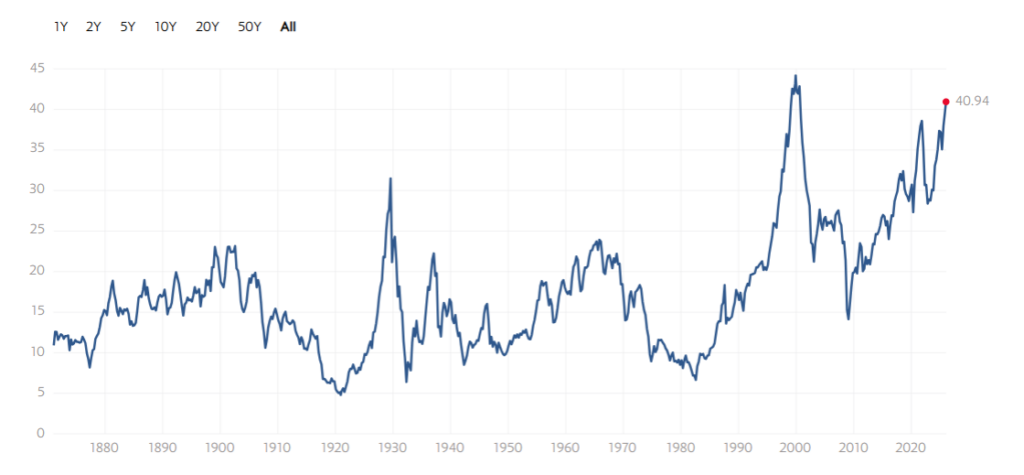
The graph reveals that the market has a long term historical mean of approximately 17. When the line moves significantly above this average, it suggests that stocks are becoming expensive relative to their history. Notable peaks occurred in 1929 at roughly 32.5 and in 2000 at an all time high of 44.2, both of which were followed by major market crashes. As of early 2026, the ratio is hovering near 40, which is higher than 99% of historical observations. While a high Shiller PE is not a tool for timing the exact moment a bubble will pop, it has a strong inverse correlation with future returns. Historically, high starting CAPE ratios have led to lower average annual returns over the subsequent 10 to 20 years as the market eventually reverts toward its mean.
While high valuations do not tell you when a crash will happen, they do tell you the level of risk you are taking. Investing in a market with a Shiller PE of 35 is fundamentally different from investing in a market with a ratio of 15. In the former scenario, you are paying a massive premium for every dollar of earnings, which leaves almost no margin of safety if things go wrong.
If you suspect a bubble but are afraid of missing out entirely, there are middle ground strategies. One such approach is dollar cost averaging. Instead of putting a lump sum into the market at potentially record highs, you invest smaller amounts at regular intervals. This ensures that if the market crashes, you are buying more shares at lower prices. The Vanguard research on dollar cost averaging highlights how this strategy can mitigate the risk of bad timing, though it may result in lower returns in a strictly bull market.
Another strategy is rebalancing. If you have a target allocation of 60 percent stocks and 40 percent bonds, a bubble will naturally push your stock allocation much higher. By selling stocks and buying bonds to return to your target, you are effectively “selling high” and “buying low” without needing to predict the exact moment the bubble will pop. This systematic approach takes the emotion out of the decision and forces you to harvest gains while the market is still exuberant.
Perhaps the greatest challenge of investing during a bubble is not the math, but the psychology. Fear of Missing Out (FOMO) is a powerful human emotion. When we see others making easy money, our logical brain shuts down and our primal desire for status and security takes over. This is why bubbles are often accompanied by a “this time is different” narrative. People convince themselves that old rules of economics no longer apply because of AI, the internet, or new monetary policies.
To protect yourself, it is essential to define a Market Bubble by its characteristics rather than its news coverage. Bubbles are characterized by high volume, price surges that follow a parabolic curve, and a sudden influx of novice investors. When you start receiving stock tips from people who have never expressed interest in finance before, it is often a sign that the bubble is nearing its end. Great investors succeed because they decouple their actions from their emotions. They recognize that the goal of investing is to grow purchasing power over time, not to “win” every single year.
Investing money in a market that you know is in a bubble is a high stakes gamble. While it is possible to make money in the short term by riding the wave of momentum, the risk of a permanent loss of capital is extreme. The most successful investors throughout history have shown that there is no shame in holding back when the odds are not in your favor. Whether you choose to exit the market entirely, move into defensive assets, or simply slow down your contributions, the key is to have a plan that does not rely on finding a “greater fool.” Wealth is built through the disciplined accumulation of undervalued or fairly valued assets, not by chasing the tail end of a speculative frenzy. By focusing on intrinsic value and maintaining a margin of safety, you can navigate the volatility of bubbles without sacrificing your financial future.