Physical Address
304 North Cardinal St.
Dorchester Center, MA 02124
Physical Address
304 North Cardinal St.
Dorchester Center, MA 02124


Investing in the stock market is more accessible than ever, thanks to commission-free trading platforms like Public. With a focus on transparency and community-driven investing, Public has positioned itself as a top contender among investment apps. But is it the right choice for you in 2025?
Investing in the stock market is more accessible than ever, thanks to commission-free trading platforms like Public. With a focus on transparency and community-driven investing, Public has positioned itself as a top contender among investment apps. But is it the right choice for you in 2025?
In this in-depth Public Investing Review, we’ll cover its features, benefits, drawbacks, and how it compares to other platforms.
Public is a commission-free trading app designed for beginner and experienced investors alike. It allows users to invest in stocks, ETFs, cryptocurrencies, and alternative assets without the complexities of traditional brokerages.
Unlike other investing platforms, Public does not rely on Payment for Order Flow (PFOF)—a controversial practice in which brokerages earn money by routing trades through specific market makers. Instead, Public sustains itself through optional fees and premium services.
[Also see: RobinHood Trading]
Public differentiates itself from competitors with a social investing platform that allows users to follow other investors, share ideas, and build portfolios with insights from financial professionals.
Public Investing is ideal for:
However, active traders or investors needing advanced technical analysis tools may find Public lacking in some areas.
Public offers a variety of tools and features that make it an appealing choice for investors in 2025.
One of Public’s biggest advantages is its no-commission trading model. Users can trade stocks, ETFs, and cryptocurrencies without paying platform fees, making it cost-effective for long-term investors.
Public allows investors to buy fractional shares, meaning you don’t need to purchase an entire share of expensive stocks like Amazon or Tesla. This makes high-priced stocks more accessible to all budgets.
Beyond traditional assets, Public now offers access to alternative investments such as:
This feature broadens investment opportunities beyond the typical stock and ETF portfolio.
One of Public’s most unique elements is social collaboration. Users can follow fellow investors, share insights, and discover market trends in a community-driven environment.
This social feature makes it especially attractive to beginners who want to learn from experienced investors in real-time.
Unlike platforms like Robinhood, Public does not generate revenue via Payment for Order Flow. Instead, it relies on alternative monetization methods such as optional tipping and premium features.
This ensures that trade execution is transparent and aligned with the best interests of investors rather than third-party market makers.
Public offers a subscription service with enhanced analytics, research tools, and exclusive content. This is ideal for users looking to take their investing strategy to the next level.
Despite its many advantages, Public has a few notable drawbacks.
Public is great for casual investors but lacks advanced charting tools and technical indicators, making it less appealing to day traders and those who rely on complex technical analysis.
Currently, Public does not support trading in options, bonds, or mutual funds. Investors looking for these asset classes may need to consider alternative platforms like Fidelity or TD Ameritrade for more comprehensive offerings.
While Public supports cryptocurrency trading, availability varies by state due to regulatory restrictions. If you live in a jurisdiction where crypto trading is restricted, you may need to use dedicated crypto exchanges like Coinbase or Binance.
When choosing the right brokerage platform, it’s essential to compare Public to its competitors. Here’s how it stacks up against other popular investing apps:
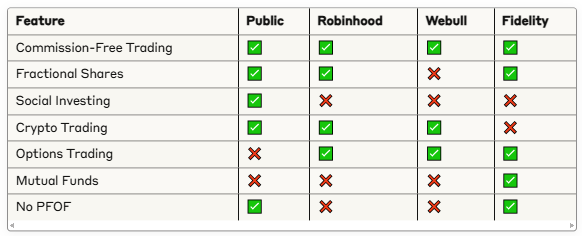
Overall, Public remains one of the most beginner-friendly commission-free trading apps on the market. It excels in community-driven investing, alternative assets, and providing a transparent user experience free from Payment for Order Flow.
However, if you need access to mutual funds, bonds, or robust charting tools, you may find Public limiting. Experienced traders and options traders might be better served with platforms like Webull or TD Ameritrade.
Public is a top-tier commission-free investing app in 2025, especially for new investors and those who value a community-focused trading experience.
With features like fractional shares, alternative assets, and social investing, Public successfully bridges the gap between trading and financial education. However, its lack of options trading and limited advanced tools could be deal-breakers for experienced investors.
If you’re looking for a simple, transparent, and user-friendly investing platform, Public is definitely worth considering. But if you require more advanced features, it may be best to explore other options.
Would you try Public Investing in 2025? Let us know in the comments! 🚀
You might also like: