Physical Address
304 North Cardinal St.
Dorchester Center, MA 02124
Physical Address
304 North Cardinal St.
Dorchester Center, MA 02124


Bitcoin is notorious for its volatility. One month it’s carving out new all‐time highs, and a few months later it can be down 30%, 40%, or even more. This feast‐or‐famine price action has led many investors to wonder: Is there a way to “time” BTC buys so you get more for your money, without trying to day‐trade a notoriously unpredictable market?
Bitcoin is notorious for its volatility. One month it’s carving out new all‐time highs, and a few months later it can be down 30%, 40%, or even more. This feast‐or‐famine price action has led many investors to wonder: Is there a way to “time” BTC buys so you get more for your money, without trying to day‐trade a notoriously unpredictable market?
One interesting approach is what we’ll call the “66% Rule.” In essence, you only buy BTC during months when its price is trading at 66% (or less) of its prior all‐time high. If the price is above that threshold, you simply wait. The idea: You only invest when you’re getting a “two‐thirds sale” (or better) relative to that peak price.
Below, we’ll explore three strategies side by side:
We’ll walk through how these played out historically (from mid‐2018 through early 2025) using actual monthly BTC data. You’ll see each strategy’s ultimate “bottom line”—the total BTC accumulated, the total amount invested, and the hypothetical final value if Bitcoin trades around $101k at the start of 2025 (as in our spreadsheet).
The 66% threshold is somewhat arbitrary, yet it reflects a major drawdown off the all‐time high. Bitcoin has historically seen drawdowns of 50%–80% or more during bear markets. For many market participants, accumulating BTC near those lower bands is attractive: they believe that as the cycle continues, BTC will eventually surpass old highs in the next bull run, making purchases at 66% or less of the ATH historically quite profitable.
Of course, no single metric guarantees future success. But if you’re the sort of investor who wants a built‐in discipline to “buy the dip,” the 66% threshold systematically enforces a wait‐and‐buy‐low mentality—without needing to guess exact bottoms on your own.
Plain DCA has been one of the most recommended approaches for Bitcoin newcomers since 2017. You simply invest the same dollar amount on a regular schedule—$100 per month in our example. You keep doing this regardless of whether Bitcoin is up, down, or sideways.
In our sample from August 2018 through the start of 2025, a steady $100 monthly DCA would have amounted to $7,800 total out of pocket (78 months). By January 2025’s close (near $101,320 per BTC in our hypothetical scenario), you’d be sitting on about 0.5359 BTC. Multiplied by $101k, that’s around $54,300 total value. Your net profit? Roughly $46,500 over $7,800 invested—about a 596% return.
In the Strict 66% model, you don’t invest unless the monthly close is 66% of the prior all‐time high or lower. The moment the market is too high (i.e., only discounted 30% or 20% from ATH), you stay on the sidelines.
An immediate difference from plain DCA is that you’ll wind up skipping certain stretches entirely. During strong rallies—when Bitcoin soars near or above old highs—you keep your money in cash. That means you’ll invest fewer total dollars over the same time period, but you’ll (hopefully) accumulate coins at discount levels.
In the sample from mid‐2018 to early 2025, a Strict 66% strategy ended up investing in only 57 of those months (because in some months the price was well above 66% of the ATH). That meant you only contributed $5,700 in total. However, the coin accumulation by early 2025 was 0.4909 BTC—not far behind the total 0.5359 BTC that plain DCA got, even though DCA invested $2,100 more.
At a hypothetical BTC price of $101,320 in January 2025, your 0.4909 BTC would be worth roughly $49,700. Subtract out your $5,700 total contributions, and you’ve made a net profit of $44,000—a whopping 772% gain on your principal.
The Modified 66% approach takes the best of both worlds from DCA and Strict 66%. You still dedicate $100 per month to Bitcoin—but instead of blindly buying every month (DCA) or skipping the month’s contribution entirely (Strict 66%), you set aside your $100 in a “cash stash” if the price is above the 66% threshold.
Then, in any month when Bitcoin’s closing price does fall below that 66% line, you invest everything you’ve saved up. For example, if you skipped three months in a row, you’d have $300 set aside, which you would invest all at once as soon as that discount arrives again.
The difference here is that you’re always prepared to buy a dip. If the dip takes several months to arrive, you’ll be plowing multiple months’ worth of saved contributions into BTC at precisely that lower price.
From August 2018 to early 2025, the Modified 66% rule ended up investing a total of $6,600, spread across fewer, larger lump‐sum purchases. That got you to about 0.514 BTC by January 2025.
At the same final BTC price ($101,320), your stash would be worth roughly $52,000, netting you about $45,400 more than your $6,600 total outlay. That translates to around a 688% gain.
Let’s line up the final outcomes, assuming you start in mid‐2018 and keep going through January 2025 (data from the spreadsheet). We’ll use our hypothetical final BTC price of around $101,320 at the close of January 2025:
| Strategy | Total Invested | BTC Accumulated | Final Value | Net Profit | ROI |
|---|---|---|---|---|---|
| DCA | $7,800 | 0.5359 BTC | $54,300 | $46,500 | 596% |
| Strict 66% | $5,700 | 0.4909 BTC | $49,700 | $44,000 | 772% |
| Modified 66% | $6,600 | 0.5140 BTC | $52,000 | $45,400 | 688% |
Each approach has merit, and your personal choice should reflect:
It’s also worth noting that the Strict 66% approach invests the smallest total capital ($5,700), which partially explains its high percentage gains. Investing less money can produce higher multiples on that capital if prices rebound strongly.
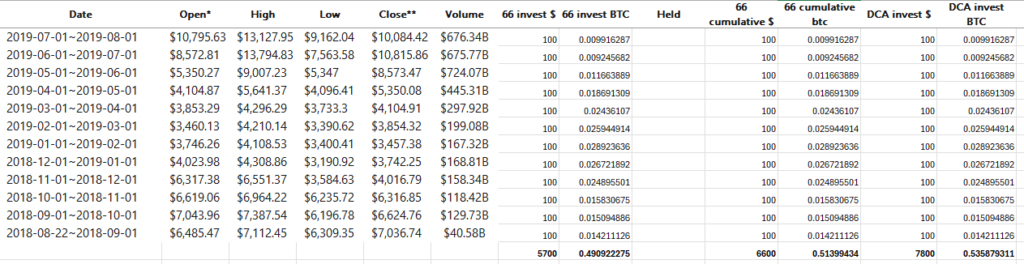
One of the best ways to gauge an investment strategy’s plausibility is to back‐test it with real historical data. In the spreadsheet from which these numbers are drawn, every monthly candle from August 2018 to January 2025 is laid out:
At the very bottom, you can see how many months each strategy actually put money into BTC (and how much BTC got accumulated). The final row multiplies that BTC balance by the hypothetical January 2025 price, revealing each strategy’s theoretical end balance.
While historical data can’t predict the future, it does illustrate patterns. This back‐test shows that, had you used a 66% discount rule over the last few cycles, you would have done extremely well compared to plain DCA—especially when looking at return on your actual dollars deployed.
Bitcoin’s future remains uncertain, and no strategy—even a back‐tested one—can guarantee profits. Always keep in mind:
Despite these caveats, discount‐buying rules like the 66% approach can help remove emotional biases: you have a clear, data‐driven green light before you deploy capital. As the back‐test suggests, had an investor used Strict or Modified 66% from 2018 to 2025, they could have garnered a handsome return relative to the capital deployed—often outpacing straightforward dollar‐cost averaging in percentage terms.
In conclusion, the 66% Rule (in either strict or modified form) might be attractive if:
Whether you choose to go 100% DCA, Strict 66%, or a Modified approach, the key is consistency. The real power of these rules is that they provide an automated, emotion‐free system for building your BTC position over the long run. And if you believe in Bitcoin’s fundamentals, sticking to any disciplined plan tends to beat jumping in and out of the market at random or based on fear and FOMO.
Ultimately, no single approach is universally “best.” But if you like the idea of only buying when BTC is at a significant discount from its highs—and you’re willing to be patient—a 66% rule just might enhance your returns without requiring complex technical analysis or constant screen‐watching. Run the numbers yourself, compare them to your personal circumstances, and see if the 66% discount strategy resonates with how you prefer to invest in Bitcoin.